


The Simple Past Tense in English
Master regular modifications, irregular inflections, and past timeline tracking with confidence.
Core Conceptual Function
The Simple Past Tense is used to describe actions, events, or situations that started and finished in the past. We use it to talk about completed actions, past experiences, past routines, and sequences of events.
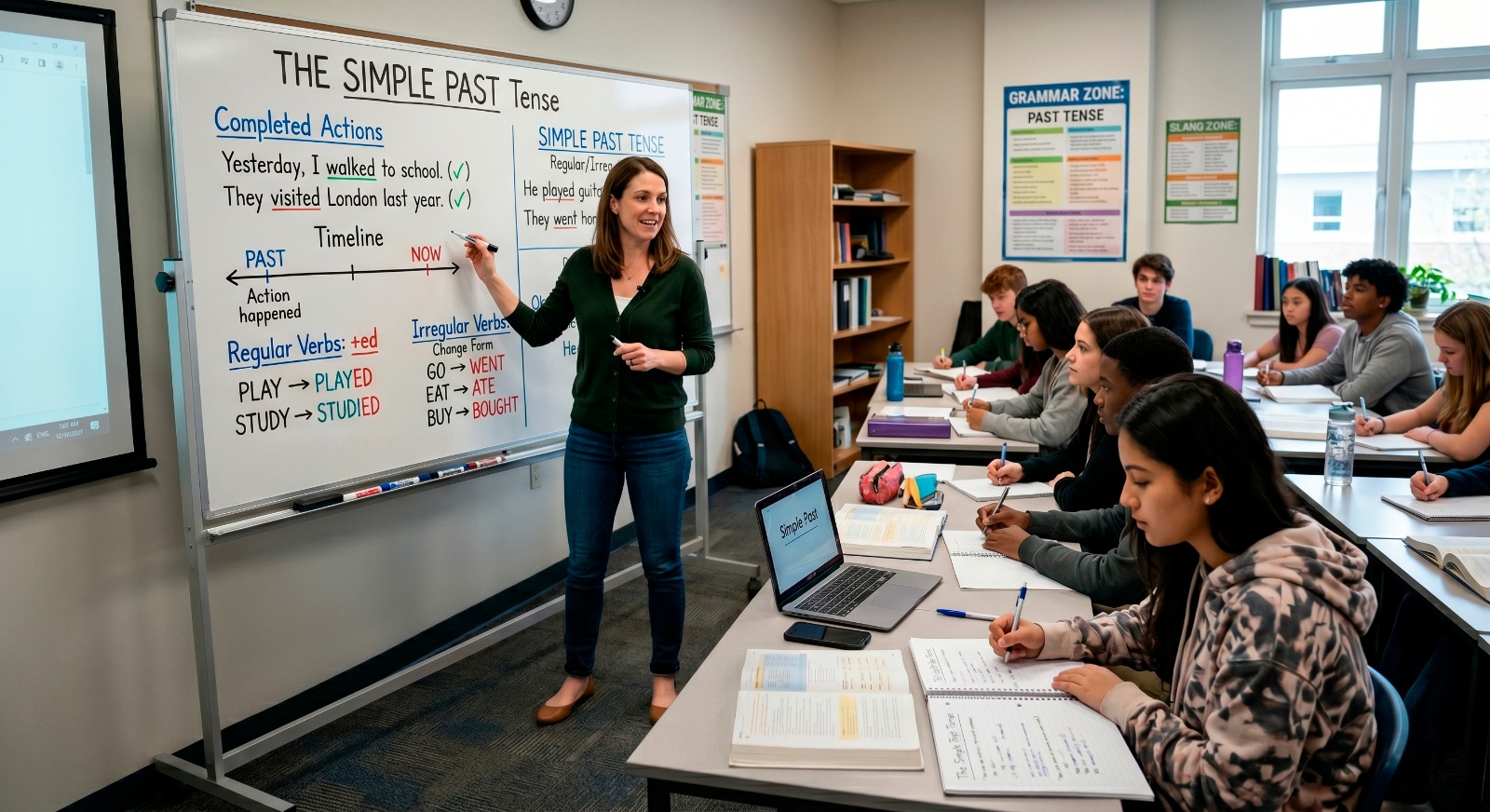
- I visited my grandmother yesterday.
- She watched a movie last night.
- We studied English for two hours.

1. Sentence Architecture
Affirmative Structural Formula

- “I played soccer yesterday.”
- “She cooked dinner last night.”
- “They visited the museum.”
2. Regular Verb Spelling Blueprints
Standard & Silent -E
- “I worked all day.”
- “They played volleyball after school.”
- “She cleaned her bedroom.”
- “We watched a documentary.”
- “We lived in Bogotá.”
- “She danced very well.”
- “He smiled at the teacher.”
Y-Shifts & Short Patterns
- “I studied for the test.”
- “They carried heavy bags.”
- “She tried the new restaurant.”
- “The bus stopped suddenly.”
- “We planned a family trip.”
- “He preferred coffee instead of tea.”
3. Irregular Verb Structural Mutations
Irregular verbs do not track standard spelling rules; their unique structures must be actively memorized:
| Base Verb | Simple Past Form | Context Operational Production |
|---|---|---|
| go | went | “She went to the supermarket.” |
| eat | ate | “I ate pizza for dinner.” |
| see | saw | “They saw a dolphin at the beach.” |
| buy | bought | “He bought a new computer.” |
| have | had | “We had a great time.” |
| make | made | “She made a delicious cake.” |
| take | took | “They took many photos.” |
| come | came | “He came to class early.” |
| write | wrote | “We wrote an email to the manager.” |
| speak | spoke | “They spoke English fluently.” |
4. Temporal Anchors & Sequence Mapping
Common Time Expressions
- yesterday (e.g., I visited my aunt yesterday.)
- last night / week / month / year (e.g., They traveled to Medellín last year.)
- ago (e.g., She called me two hours ago.)
- in 2020 / this morning (if completely finished)
Sequence & Signal Tracking
Use simple past forms sequentially to outline actions in order:
“I woke up, took a shower, ate breakfast, and left for work.”
Signal Keys: yesterday, ago, last, when, then.
5. Structural Accuracy Error Verification
6. Situational Dialogue Application
7. Interactive Concept Practice Workspace
Complete the sentences using the correct Simple Past form. (Type answers in lowercase)
💡 Summary Checklist Rule: Always keep your regular and irregular verbs distinct! Regular past forms usually finish in -ed, while irregular verbs feature specialized spellings that bypass patterns completely. Keep an eye out for signal words to quickly identify when a past timeline framework is needed.